
Meridian, ID · Boise · Eagle · Nampa
Every stair is a decision. Every morning, you test the knee before you trust it. You've heard "bone on bone." You've heard "eventually." Before you schedule anything, let's find out exactly what's driving your pain — and how much of it can still be treated.


If you're on your feet all day — concrete, ladders, job sites, or just a long shift standing — your knees absorb everything you put on them. Kneeling. Standing back up. Stairs. By the afternoon, one knee starts talking louder than the other. By evening, you're favoring it without even meaning to. And somewhere along the way, you got the words that changed how you think about your own body: bone on bone. Eventually, a replacement.
If you're in Meridian, Boise, Eagle, or Nampa, here's the truth: waiting to find out what's actually driving your pain doesn't make the joint better. It just means more months of favoring it, more compensating, and less information by the time you finally decide what to do. This is where we start.
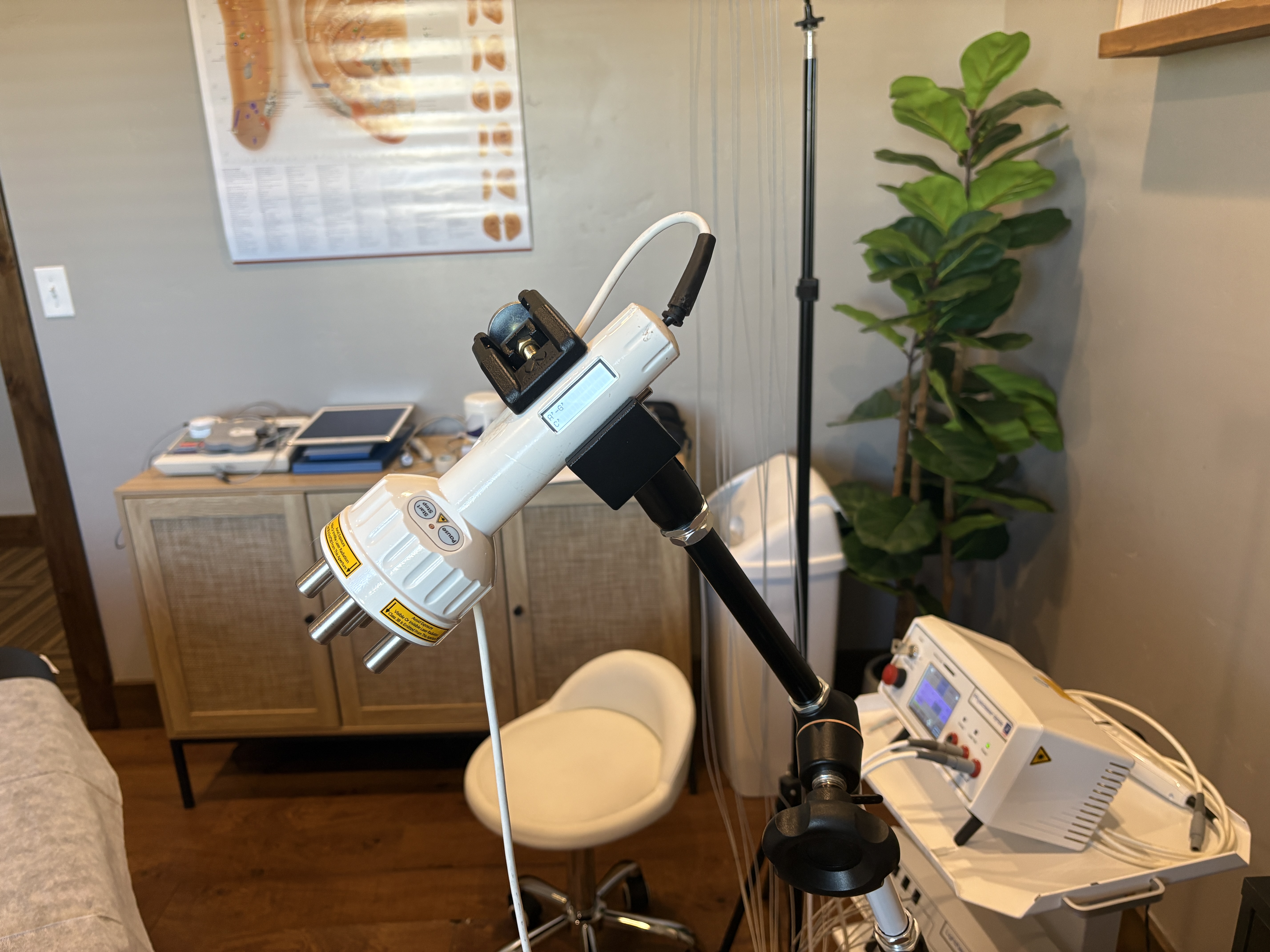
We use a unique German-engineered super-pulsed laser, and for knees — especially bone-on-bone knees — we use its cluster probe to deliver concentrated photobiomodulation therapy directly into the joint and the tissue surrounding it. This isn't a heat lamp or a gimmick: it's a specific wavelength of light that stimulates mitochondrial activity inside your own cells, giving your body the energy it needs to actually repair itself.
From the Treatment Room
I had a patient who works concrete all day — on his knees, on hard surfaces, day after day. By the end of most days, his knees were done. He'd start limping without even realizing it. His doctor had told him: bone on bone, and eventually you're going to need a knee replacement.
We started him on the super-pulsed laser with the cluster probe. After three or four treatments, he told me he couldn't believe how much better his knees felt. By his fifth treatment, he said something I still think about — he had to consciously tell himself to stop limping, because his knees simply didn't hurt anymore.
Now, I'm not going to tell you this laser regrows a knee that's completely bone on bone, because that isn't true. What it can do is stimulate real repair in the tissue that's still there — the remaining cartilage, the inflamed synovium, the soft tissue around the joint — and for a lot of patients, that's enough to substantially reduce pain and keep the joint moving well. For some patients, that means holding off a knee replacement for years — sometimes many years — while they keep working, keep moving, and keep living without surgery.
That's not a promise we make to every patient who walks through our door. But it's exactly the kind of change we set out to create — for a knee a lot of people had already written off.

Not every knee problem starts in the knee. The knee is a hinge caught between two much bigger, more powerful joints — the hip above it and the ankle below — and restriction or scar tissue in either one can force the knee to move, track, and load wrong, producing very real pain in a joint that was never actually the problem.
Osteoarthritis and bone-on-bone changes, meniscus tears, ligament strain, and patellar tracking problems. Pain is localized to the joint itself, often worse with impact, kneeling, or deep bend.
Restriction in the IT band, quadriceps, or hamstring, and scar tissue from a prior hip or knee surgery, can all pull the kneecap and joint out of proper alignment — producing knee pain that treating the knee alone never resolves.
From the Treatment Room
I once had a patient who came in complaining about her knee. We worked directly on the knee for several appointments without much progress. As I started troubleshooting further up the leg, I could feel restriction moving up her IT band, and her quadriceps and hamstring were extremely tight and full of scar tissue. When I asked what kind of injury could have caused that much tissue restriction, she said, “Oh — I had a hip replacement two years ago.”
We spent the next two appointments treating the hip and clearing out the surgical scar tissue instead of the knee itself. Her knee pain went away completely. The knee was never really the problem — it was just where she felt it.
This is exactly why we don't just treat the spot that hurts. Get this wrong, and you could spend months — and thousands of dollars in a surgeon's office — treating a knee that was never the actual source. We trace the pattern up and down the leg first, so we're treating the real cause, not just the location.

Before we treat anything, we map your pain: where exactly it is, what makes it worse, and whether it matches true joint involvement or looks more like a mechanical pattern coming from above or below the knee. We check how the kneecap tracks, assess the IT band, quadriceps, and hamstring for restriction, and ask about any prior hip, knee, or leg surgery — because surgical scar tissue is one of the most common hidden drivers of knee pain we find.
If your imaging shows real degenerative change, we won't pretend it doesn't exist. But imaging alone rarely tells the whole story of why a knee hurts as much as it does — that takes an actual hands-on assessment of how the joint is moving and what's restricting it.
Our unique German-engineered laser is the centerpiece of treatment for bone-on-bone and arthritic knees. Needle-free. No downtime. It stimulates real repair in the tissue you still have, calms inflammation, and reduces pain — often meaningfully — over a course of treatment.
Clears the dense, restrictive scar tissue and adhesion in the IT band, quadriceps, hamstring, and patellar tendon — including scar tissue left behind by a prior hip or knee surgery — that's quietly forcing your knee to track and load wrong every single day.
Calms the inflammatory component of joint pain and supports pain-signal modulation — especially valuable when real arthritis is part of the picture, and something most conventional care never addresses directly.
Between these three approaches, we're able to address most of what actually causes knee pain: osteoarthritis and bone-on-bone changes, meniscus irritation, patellofemoral and tracking problems, IT band syndrome, tendonitis and bursitis, post-surgical scar tissue from a hip or knee replacement, and pain referred from the hip or low back. Whatever's driving yours, we're going to find it.
We're not going to tell you every bone-on-bone knee avoids replacement forever, because that isn't true, and we don't build this practice on promises we can't back up. If your joint has severe structural degeneration, there's a real physical limit to what any non-surgical treatment can do to the joint surface itself — and at some point, for some patients, surgery is genuinely the right answer.
What we can tell you honestly: a large share of the pain that comes with a bone-on-bone knee isn't purely from bone contacting bone — it's from the inflammation, the soft-tissue guarding, and the compensation patterns built up around a joint that isn't moving well. That part responds very well to treatment, often even in patients with significant arthritis on imaging. We've worked with patients who were told a replacement was coming “eventually” and found enough real relief to comfortably delay that decision for years. We'll tell you early which category your case looks like, based on your actual pattern — not on what sounds best walking in the door. We'd rather tell you the truth now than have you disappointed six months from now.

"I've already tried physical therapy, injections, or other treatments, and nothing worked."
Most of those approaches manage symptoms. This is one of the only options built specifically to target tissue repair itself — a different mechanism entirely, and often the missing piece for patients who've already tried everything else.
"This sounds too good to be true for a knee that's already bone on bone."
We're not promising a miracle, and we'll tell you plainly if your case looks more structural than tissue-driven. But we've watched patients who were told surgery was their only option find years of real relief instead. It's worth finding out which category you're actually in before you assume you know the answer.
"I don't have time to add more appointments to my week."
Neither did the concrete worker who couldn't stop limping by the end of his shifts. What he didn't have time for, it turned out, was more years of compensating around a knee that kept getting worse. A handful of sessions is a small trade against that.
Often, yes. We'll give you an honest evaluation of how much of your pain is treatable inflammation and soft-tissue restriction versus true structural degeneration, so you can make that surgical decision on your own timeline, with real relief in the meantime.
It won't regrow bone that's worn away, but the photobiomodulation effect on the remaining tissue — cartilage, synovium, and surrounding soft tissue — is well documented, and we've seen it produce real, substantial pain reduction, including in patients told they were headed straight for surgery.
That's often a sign the true source is somewhere else — the hip, the IT band, or scar tissue from a past surgery pulling the knee out of its normal track. We'll check above and below the joint, not just the joint itself.
Often, yes. Surgical scar tissue is one of the most common and most overlooked causes of ongoing pain after a joint replacement, and Adhesion Release Method is built specifically to address it.
It depends on how advanced the degeneration is and how much of your pain is coming from restriction versus the joint itself. We'll give you a realistic plan after evaluating your specific pattern.
In addition to, not instead of. We're not replacing your physician's diagnosis or management — we're adding a treatment approach aimed directly at the pain and tissue itself, which most conventional care doesn't offer.
Degeneration doesn't pause while you decide. The favoring, the guarding, the extra strain building in your hip and back from compensating — all of it gets more entrenched the longer it runs. The sooner we find out exactly what's driving your pain, the more options you still have. Serving patients across Meridian, Boise, Eagle, and Nampa.
Book a Treatment