
Meridian, ID · Boise · Eagle · Nampa
You've done the physical therapy. You've had the injections. Maybe you've even had the surgery. And you still can't lift your arm without that catch, that pinch, that tightness halfway up. There's a reason — and it's often something your MRI was never going to show you.
 Book a Treatment
Reaching for the seatbelt. Pulling a shirt over your head. Sliding your arm into a jacket sleeve. Reaching into the back seat for your bag. Every one of them has become a small negotiation with your own shoulder. And at night? You roll onto it the wrong way and you're wide awake at 2 a.m., hunting for a position that doesn't hurt.
And the worst part? Nobody has told you why it's still happening.
If you're in Meridian, Boise, Eagle, or Nampa and any of those hit home, keep reading. This page was written for you.
Shoulders are complicated, and no two cases look alike. Here's where we see the most change.
We see a lot of these — and they respond very well to treatment.
Including partial supraspinatus tears. Often a strong candidate for treatment before anyone talks surgery.
Some frozen shoulders turn around in just 2–3 treatments — sometimes it's miraculous. Others are locked in deep and take real time and effort to unfreeze. We'll tell you which one yours looks like.
Heading into surgery, or years past it and still tight? The scar tissue is often the missing piece.

The Super-Pulsed Laser Difference
Here's what most shoulder patients are never told: a partial rotator cuff tear or a labral tear is not a sentence to "rest it, ice it, and wait for surgery." Damaged shoulder tissue can regenerate. What it has been missing is a strong enough stimulus to start the repair.
The super-pulsed laser delivers deep light energy straight into the torn tendon and labrum, right where the damage lives. That energy wakes up the cells responsible for repair, drives blood flow into tissue that normally gets very little of it, and calms the inflammation that keeps the shoulder angry. The tissue stops just hurting and starts rebuilding.
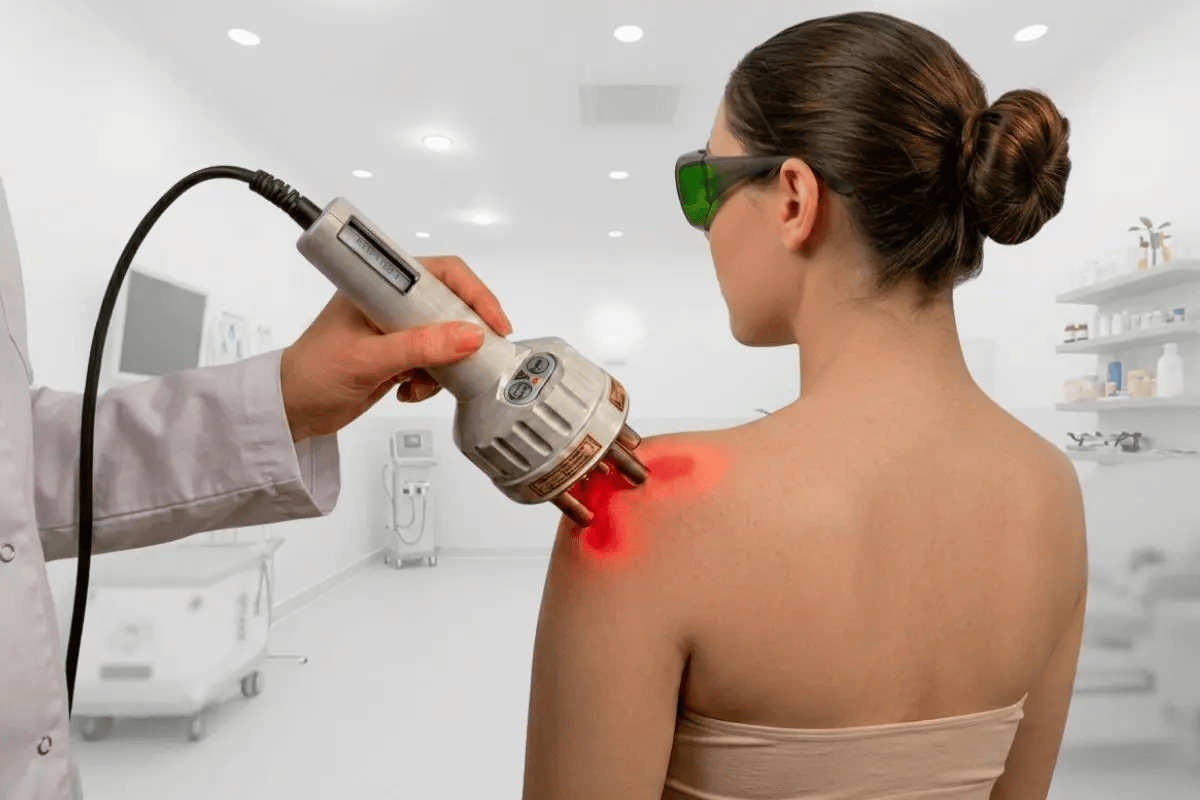
Let's be straight about the limit: a complete, full-thickness tear is a much harder case and may still need a surgeon. But partial tears and labral tears are where this laser shines, and they are exactly the diagnoses where patients are most often told to wait.
If your MRI says "partial tear" or "labral tear," don't accept "wait and see" as the plan.
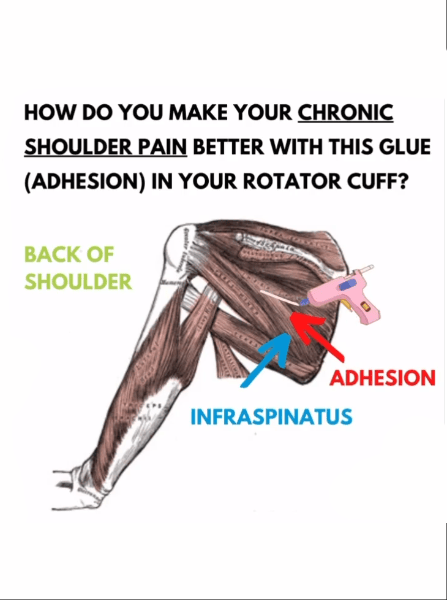
Surgery can fix the structure. But every incision, every repair, every anchor leaves something behind: scar tissue. And that adhesion doesn't stay politely in one spot. It glues muscle to muscle, fascia to capsule, and slowly turns a shoulder that should glide into one that drags.
That's why so many people tell us the same thing: “My range of motion is pretty good. But somewhere around halfway up — right about 45 degrees — there's a catch, a tightness, a little jolt of pain.” That's not your imagination, and it's not something you just have to live with. It's very often adhesion.
When we break up the significant scar tissue left behind by shoulder surgery, we get tremendous results.
From the Treatment Room
I had a woman come in, about 65 years old, with two shoulders that simply wouldn't move. One shoulder had been through three surgeries and was completely immovable. The other was also damaged — and her surgeon had refused to operate on it. Essentially, she had two completely immobile shoulders.
We started with the shoulder that had never been operated on. In about six treatments, she had roughly 80% of her full range of motion — just by breaking up all the adhesion and scar tissue.
Not by cutting. Not by medication. By getting the scar tissue to let go.
From a Google Review
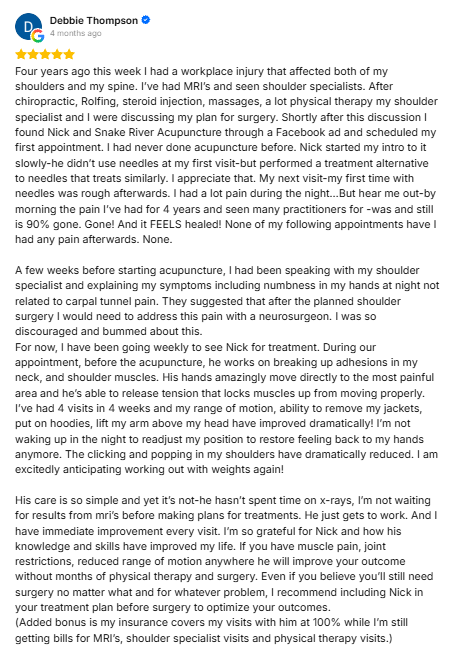
— Google Review, Snake River Acupuncture
The shoulder isn't an island. Muscles and fascia tie your shoulder blade to your neck, your upper back, and your rib cage. When a shoulder is injured, guarded, or scarred from surgery, everything connected to it gets pulled, and the pain often shows up somewhere you didn't expect.
A tight, restricted shoulder is one of the most overlooked causes of a neck that never fully lets go. Stretching the neck while the shoulder stays locked is chasing the symptom.
Soft tissue restriction around the shoulder blade can drag on the ribs, causing a deep ache along the back and side that no one can quite explain.
The muscles that pull your shoulder forward attach across the front of your chest. When they bind up, it can feel like pressure or tightness right there.
Important: new chest pain, especially with shortness of breath, sweating, or pain spreading into your jaw or arm, needs emergency medical care first. Don't wait on it.
Many patients are surprised by how simple and direct this is. We don't need weeks of imaging before we start. We use our hands to find exactly where the tissue is locked, and we go to work on it.
Hands-on assessment of the shoulder, neck, upper back, and ribs to find where the adhesion and tension are actually holding you back.
Adhesion Release Method is the centerpiece, targeting scar tissue from old injuries and from surgery that keeps the shoulder from gliding the way it should.
Acupuncture to calm inflammation and pain signaling, with our German-engineered super-pulsed laser added where it can help support tissue repair, as in labral and partial rotator cuff cases.
Not every shoulder avoids surgery. A complete, full-thickness tear or a seriously damaged structure may genuinely need a surgeon, and we'll tell you so rather than waste your time and money.
Not every frozen shoulder is a 2–3 treatment miracle either. Some are locked in hard, and unfreezing them takes real time and effort from both of us.
But here's what we've seen again and again: even when surgery is the plan, getting the scar tissue and restriction under control first puts you in a far better position, and after surgery it's often what separates a shoulder that feels fixed from one that still feels tight. We'll tell you early where you stand, based on your actual shoulder, not on what sounds best.
“I'm already scheduled for surgery.”
That's exactly when to come in. Getting the adhesion and restriction under control before surgery can put you in a better position going in, and as one patient put it, it's worth including us in your plan before surgery to optimize your outcome.
“I already tried months of physical therapy.”
Stretching and strengthening work around a shoulder. They can't always release scar tissue that has bound it down. This is a different tool for a different part of the problem.
“My surgery was years ago. It's too late.”
Scar tissue from an old surgery is still scar tissue, and it can still be treated. The tightness you've been told to live with may not be permanent at all.
Many patients do. Getting restriction under control before surgery can help, and we'll tell you honestly whether your case looks like surgery is unavoidable.
Often, yes. Tightness, restriction, and a catch of pain partway up the arm after surgery are very commonly caused by adhesion, which is what we target.
We see many labral tears that respond very well, and partial rotator cuff tears, including partial supraspinatus tears, are often good candidates for treatment. A complete tear needs an honest evaluation first.
Some frozen shoulders improve dramatically in 2–3 treatments. Others are locked in much harder and take considerably more time and effort. We'll tell you early which one yours looks like.
The shoulder, neck, upper back, and ribs are tied together by muscle and fascia. A restricted shoulder commonly pulls on all of them, so we evaluate the whole region.
Releasing restricted tissue involves pressure and a distinct sensation, and some people feel sore afterward. We'll talk through what to expect before we start.
Scar tissue and guarding don't loosen on their own. The longer they stay, the more entrenched they become, and the more your neck, back, and sleep pay for it. Whether you're heading toward surgery or years past it, the sooner we find out what's holding your shoulder back, the more options you have. Serving Meridian, Boise, Eagle, and Nampa.
Book a Treatment