
Meridian, ID · Boise · Eagle · Nampa
Most people call it a pinched nerve. What's actually happening, in case after case, is nerve entrapment — a nerve physically trapped inside old scar tissue from an injury you probably forgot about years ago.
You've been told it's a pinched nerve. Or arthritis. Or “just getting older.” You've spent years going to chiropractors, doctors, and physical therapists for the same pain, over and over, and you already know the pattern by heart. The chiropractor adjusts you and you feel better for two days, then it's back. The physical therapist gives you exercises that help a little, but never actually resolve it. Eventually a doctor looks at your imaging, shrugs, and starts talking about surgery, or hands you a referral to pain management and a prescription.
Does any of this sound familiar?
Here's what almost none of them are trained to look for: a nerve that is physically entrapped by adhesion — scar tissue that has built up around and over the nerve itself, from an old injury, and is now literally squeezing or tethering it in place. Chiropractic adjustments move joints. Physical therapy strengthens and stretches muscles. Neither one is designed to find and release a nerve that's stuck inside fibrous scar tissue deep in the soft tissue. That's the honest, uncomfortable truth behind an enormous number of “unexplained” chronic pain cases we see walk through our door in Meridian, Boise, Eagle, and Nampa.

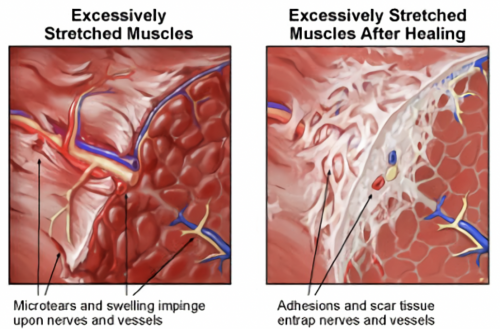
Every time your body sustains a soft-tissue injury — a pulled muscle, a bad fall, a car accident, even a “minor” sprain you walked off in a day or two — your body responds by laying down new tissue to repair the damage. That's a good thing; it's how you heal. But the repair process doesn't always happen cleanly. Instead of new tissue forming in smooth, organized layers that glide freely against everything around them, it can form in a dense, disorganized, fibrous tangle — what we call adhesion, or scar tissue.
Here's the part that matters most: your nerves run directly through and between your muscles, tendons, and fascia. If an injury happens near a nerve's path, the scar tissue that forms during healing doesn't know to avoid the nerve. It can form directly around it, over it, and through the surrounding tissue the nerve depends on to glide freely every time you move. Over months and years, that adhesion can tighten, thicken, and essentially seal the nerve in place — trapping it so it can no longer move, stretch, or glide the way it's supposed to.
A nerve that's healthy glides. A nerve that's entrapped gets pulled on, compressed, and irritated every single time you move in a way that used to be effortless. That's when the pain starts — not months after the original injury, but sometimes decades later.
This is the part that confuses almost every patient we see, and it's the reason so many people never connect their current pain to an old injury: entrapment doesn't hurt right away.
A hard fall playing sports, a fender bender, a strained back moving furniture. Sore for a week or two, then healed. No lingering pain. Scar tissue quietly forms during healing, with no symptoms.
Decades of slow tightening and thickening finally close the trap around the nerve. Pain, tingling, weakness, or burning shows up seemingly out of nowhere — in a person who “hasn't done anything” to explain it.
This is exactly why so many patients tell us some version of the same thing: “I don't understand it, I didn't injure myself, I just woke up one day and this pain was here and it's never left.” They're not wrong that nothing recently caused it. The cause happened years ago. It just took that long for the scar tissue to finish closing the trap.
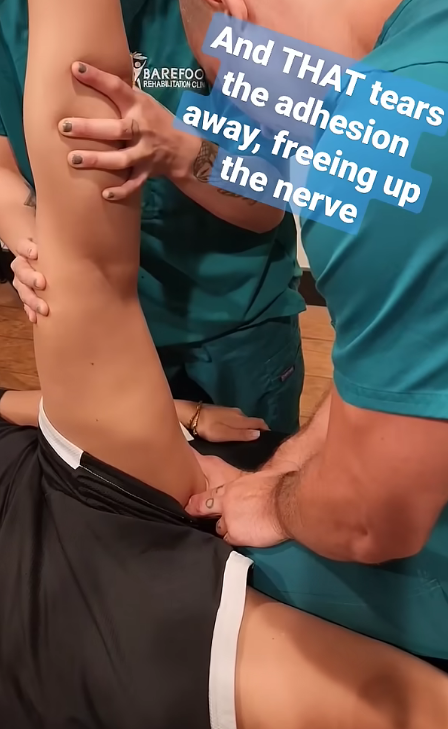
This is where Adhesion Release Method (ARM) does something most other approaches simply can't. ARM is a manual technique built specifically to feel for these dense, restricted bands of adhesion in the soft tissue — to locate, by touch, exactly where tissue has stopped gliding the way healthy tissue should, and exactly where a nerve is being tethered or compressed by that restriction.
This isn't guesswork, and it isn't generic massage. It's a deliberate, trained process of feeling your tissue for the specific texture and restriction pattern of scar tissue wrapped around a nerve, then working directly on that restriction to release it — freeing the nerve to move and glide the way it's supposed to again.
We've had patients walk in who had been in pain for fifteen years. Fifteen years of chiropractic visits. Fifteen years of physical therapists. Multiple doctors, multiple diagnoses, multiple recommendations for injections or surgery, and fifteen years of a problem that never actually went away — just got managed, poorly, on and off. In a case like that, once we locate the actual adhesion trapping the nerve, which often takes just two sessions to identify precisely, the change can happen remarkably fast. We've seen patients go from fifteen years of chronic pain to roughly 90% pain-free within days of that adhesion finally being released.
A shoulder that's ached for a decade, traced back to scar tissue from a fall in someone's twenties.
Hip and leg pain multiple doctors called “just arthritis,” traced back to an old car accident no one ever connected to the current symptoms.
A chronic low back pain case that failed two rounds of physical therapy, resolved once we found the actual entrapped nerve underneath layers of old scar tissue that had built up quietly for years.

Not because we did anything magical, but because we found and fixed the actual mechanical problem that every prior treatment had been working around instead of through.
The clearest signs are chronic pain that hasn't responded to chiropractic care, physical therapy, or standard treatment; pain that seems to have come out of nowhere with no recent injury; and a history, even a distant one, of an injury near the area that hurts now. We'll evaluate your specific case and tell you honestly whether entrapment looks like the driver.
Yes, and it's more common than most people realize. Scar tissue tightens and matures slowly over years, which is exactly why symptoms so often show up long after the original injury is a distant memory.
Every case is different, but locating the specific adhesion is often possible within the first one or two sessions. From there, treatment focuses on releasing that restriction and restoring normal nerve glide.
You may feel pressure or a distinct sensation as we work directly on the restricted tissue, but this is a targeted, controlled manual technique, not aggressive manipulation.
Because those treatments are built to address joint alignment and muscle strength, not to locate and release scar tissue that has entrapped a nerve. If that's the actual source of your pain, treatments aimed at joints and muscles were never going to fully resolve it, no matter how many times you tried them.
Close enough that most people use “pinched nerve” to describe what we call nerve entrapment. A pinched nerve is usually thought of as sudden, direct compression — something pressing on a nerve right now. Nerve entrapment specifically means a nerve trapped inside adhesion or scar tissue that's built up over time, often from an old injury. The symptoms can feel identical. The fix is different: you have to release the tissue that's doing the trapping.
Serving patients across Meridian, Boise, Eagle, and Nampa. If you've been in pain for years and nothing has worked, this may be why.
Schedule Your Evaluation