Deep buttock pain that acts like sciatica but isn't coming from your spine at all. We test to find out which one you actually have.
Book Your Evaluation
It's a deep, aching pain in one side of your buttock — the kind that makes a long car ride feel like an hour on a wooden bench.
Sitting is the worst part. So are stairs. So, for a lot of people, is just crossing that leg over the other one.
Sometimes it stops right there, in the glute and hip. Sometimes it runs partway down the back of your thigh. And because that description sounds so much like sciatica, you've probably already been told you have sciatica — and treated for a spine problem that was never actually in your spine.
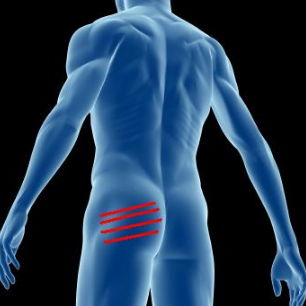
Your piriformis is a small, deep muscle that runs from your sacrum to the top of your thigh bone, sitting almost directly on top of your sciatic nerve — and in a meaningful number of people, the nerve actually runs straight through part of the muscle instead of just underneath it. When that muscle gets tight, inflamed, or bound up in adhesions from an old injury, a fall, or just years of prolonged sitting, it can compress the sciatic nerve right at the hip.
The result feels a lot like spinal sciatica. But there are real differences, and they matter for how you get treated:
Where it stays. True spinal sciatica typically travels the full length of the leg, often below the knee, sometimes into the foot. Piriformis-driven pain frequently stays concentrated in the buttock and upper thigh, though it can extend further.
What sets it off. Sitting on a hard surface, sitting on a wallet, climbing stairs, and crossing your legs are classic piriformis triggers — mechanical compression from a specific position, not the disc-related triggers (bending, coughing, sneezing) that tend to aggravate a true disc-driven sciatica.
What "fixes" it, and what doesn't. A treatment plan built for a lumbar disc — an epidural injection, spinal traction, disc-focused physical therapy — does very little for a problem that's actually happening at the hip.
If you've had imaging of your spine come back "unremarkable" while you're still in real pain, that's often the biggest clue you're dealing with this instead.

Maybe it's the drive out of Boise you used to actually enjoy — now you're shifting in your seat before you've even hit the highway, trying to find five minutes of relief in a two-hour trip.
Road trips have turned into a math problem: how many rest stops, how much longer can I go before I have to stand up and shake this out. You've started avoiding trips you'd have said yes to without a second thought a year ago.
It's not just driving. It's the movie you cut short because sitting through it wasn't worth the pain afterward. It's the church pew, the folding chair at your kid's game, the flight you're already dreading before you've even booked it. Anything that keeps you seated for more than twenty or thirty minutes turns into an endurance test.
And for a lot of people, it's not a vague ache — it's a very specific spot.
Right on the sit bone.

That bony point you're actually resting your weight on when you sit, and it feels bruised, even though nothing hit it.
You've probably pressed on it yourself, wondering if there's a bruise you can't see. There usually isn't. What's actually going on is deeper — inflammation and nerve irritation around that whole deep gluteal region, with the piriformis very often at the center of it, even when the pain you feel seems to be radiating from a single point.
Here's what makes this particular kind of pain so demoralizing: it doesn't respond to the things that are supposed to help. A cushion doesn't fix it — you've probably already bought two or three, trying to find the one that finally works. Standing up and walking it off helps for a few minutes and then it's right back once you sit again. Over-the-counter pain relievers take the edge off but don't touch the actual problem.
And unlike a lot of pain that eases with rest, this is a pain that rest itself seems to make worse — because rest, for this, usually means sitting. That's the cruelest part of piriformis-related sit bone pain. The thing your body wants to do to recover — sit down, take it easy — is often the exact position that aggravates it most. You're not imagining that contradiction. It's real, and it's precisely why generic advice like "just rest it" or "ice and elevate" so often falls flat for this specific kind of pain.
Rest helps a sprained ankle. It doesn't help a muscle that's compressing a nerve every time you load weight onto it. If any of this sounds familiar — the car rides you dread, the sit bone ache that no cushion has ever really solved, the frustration of a pain that gets worse with the very thing you're told will help — that's not a coincidence. That's piriformis syndrome behaving exactly the way it behaves.
And it's exactly what we test for.
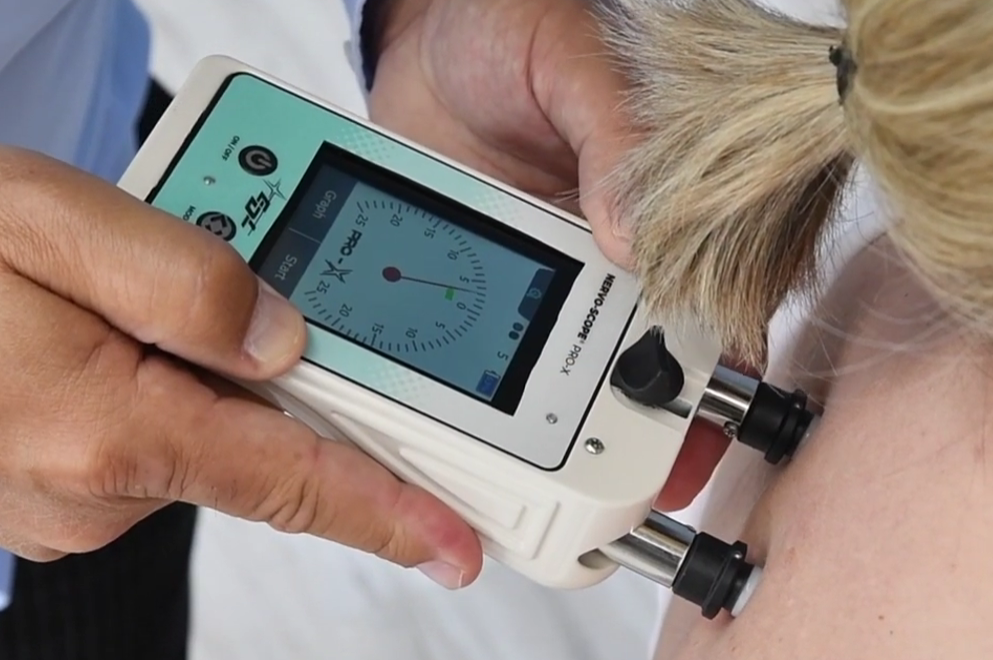
Before we treat anything, we test. That includes specific orthopedic maneuvers that provoke the piriformis directly, along with applied kinesiology muscle testing to assess the muscle's function and involvement.
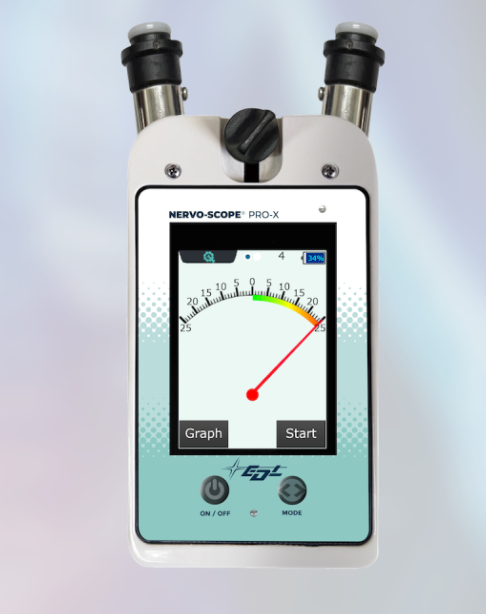
We also run our paraspinal temperature scan on your lower spine — not because we expect to find the problem there, but because ruling it out matters. A quiet, low reading at your spine, combined with piriformis-specific provocation tests reproducing your exact pain, points to a hip-level problem, not a spinal one — and that changes where we focus treatment entirely.
Treatment for piriformis syndrome usually leads with a different tool than a spine-driven case would.
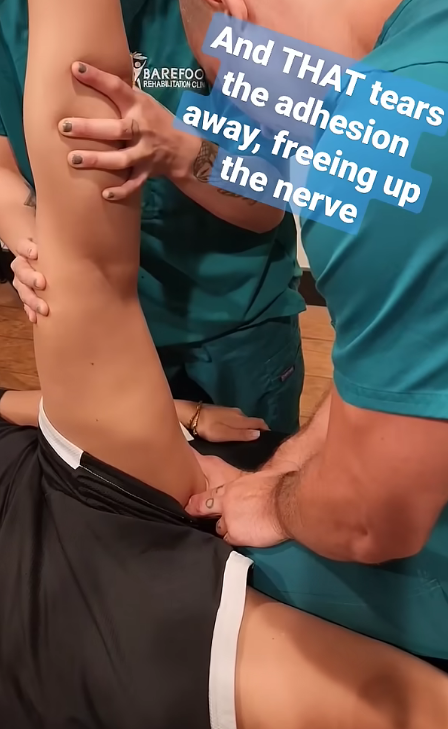
Adhesions that build up within and around the piriformis muscle — from an old fall, a hip injury, or just years of sitting — physically bind the muscle down and keep it compressing the nerve underneath or through it. Stretching alone rarely resolves this, because a stretch lengthens a muscle temporarily; it doesn't release tissue that's actually stuck. ARM locates those specific adhesions and manually releases them.
The piriformis sits deep in the glute, under a substantial layer of muscle and tissue. Our laser is built to reach that depth, helping calm inflammation and break down restricted tissue at the piriformis itself — a needle-free option for an area some people find too sensitive for direct manual pressure at first.
.jpg)
To calm the sciatic nerve's irritation and quiet the muscle spasm that develops around a compressed nerve, regardless of whether the compression originates at the hip or the spine.
If you've searched for piriformis stretches online and tried them faithfully with only partial or temporary relief, you're not doing them wrong. Stretching addresses muscle tightness — a real part of the picture, but not the adhesions that may be physically binding the muscle down. That's a structural problem, and structural problems don't resolve with flexibility work alone. It's the same reason why chiropractic adjustments don't work either. It's the same reason a stretch might feel great for an hour and then the pain returns exactly where it was.
We'll ask specifically about sitting, driving, stairs, and leg-crossing — details that matter far more for piriformis syndrome than they do for most other back or hip complaints.
What positions and activities set it off, and what you've already tried — including stretching.
Piriformis-specific orthopedic maneuvers, applied kinesiology, and our paraspinal scan to rule the spine in or out.
A plan built around what we actually find, typically leading with ARM given how central adhesions usually are to this condition.
The symptoms overlap, but the source doesn't. If your case turns out to be a true disc-driven sciatica or herniated disc instead, we'll tell you and adjust your plan accordingly — we test before assuming either one.
Often as a complement to treatment, yes — but usually not as a stand-alone fix if adhesions are the main driver, which they frequently are in cases that haven't responded to stretching alone already.
Acupuncture is minimally felt by most people. ARM involves direct, focused pressure on a specific muscle, which can be intense in the moment but is not designed to cause lasting discomfort. The laser is painless.
It depends on how long the adhesions have had time to build up and how involved the muscle is. We'll give you a specific estimate after your evaluation.
No. You can schedule directly with us.
If months of care aimed at your back haven't touched a pain that's really coming from your hip, that's not a reason to give up — it's a reason to get tested properly before trying again.
Serving Meridian, Boise, Eagle, Nampa, Star, Kuna, and Caldwell.