Sciatica Relief: We Find the Real Cause of That Shooting Leg Pain
Sciatica isn't one problem — it's a symptom with more than one possible source. We test before we treat, so the plan actually matches what's wrong.
Book Your Evaluation
It starts in your low back or your hip. Then it doesn't stay there.
It runs down the back of your leg like someone plugged a live wire into your spine. Some days it's a dull, electric hum. Other days it's a jolt that drops you mid-stride — reaching for a shopping cart, getting out of the car, bending down to tie your shoe. You've learned to brace for it before you even move.
You know this pain. You've probably had a name for it for a while: sciatica. It's one of the most common reasons people in Meridian and across the Treasure Valley end up searching for a way out of chronic leg and low back pain.
And you've probably already tried to fix it. Maybe it was a chiropractor — a few weeks of adjustments that helped for a day or two before the pain crept back in, exactly where it was. Maybe it was physical therapy — a folder of stretches you did faithfully for six weeks with nothing to show for it. Maybe it was a cortisone shot that felt like a miracle for eight days and then wore off like it never happened. Maybe you got an MRI, and a doctor told you it looked "basically normal" — which felt like an insult, because normal does not run down your leg like this.
Here's the thing nobody explained to you clearly: sciatica isn't a diagnosis. It's a description of a symptom — nerve pain traveling down the leg. It tells you where it hurts. It doesn't tell you why. And if nobody figures out why, you can chase the symptom for years without ever touching the cause.

Why the standard playbook keeps missing
Most sciatica treatment assumes one thing: a disc in your lower back is pinching a nerve root, so treatment should focus entirely on your spine. Sometimes that's exactly right. But sciatic nerve pain has more than one source, and the two most common ones get treated as if they're the same problem when they're not.
True sciatica originates at the spine — a herniated or bulging disc, or degenerative changes, compressing a nerve root before it ever gets to your leg.
Piriformis syndrome happens lower down. The piriformis muscle, deep in your glute, runs directly over — or in some people, straight through — the sciatic nerve. When that muscle gets tight, inflamed, or bound up in adhesions, it can compress the nerve at the hip, producing pain that feels almost identical to spinal sciatica. Same electric shock down the leg. Same numbness in the foot. Completely different origin, completely different fix. Read more about piriformis syndrome and how it differs from sciatica

If you've had months of care aimed at the wrong target, that's not a reason to give up. It's a reason to find out what's actually happening before trying again.
We scan for the source before we treat anything.
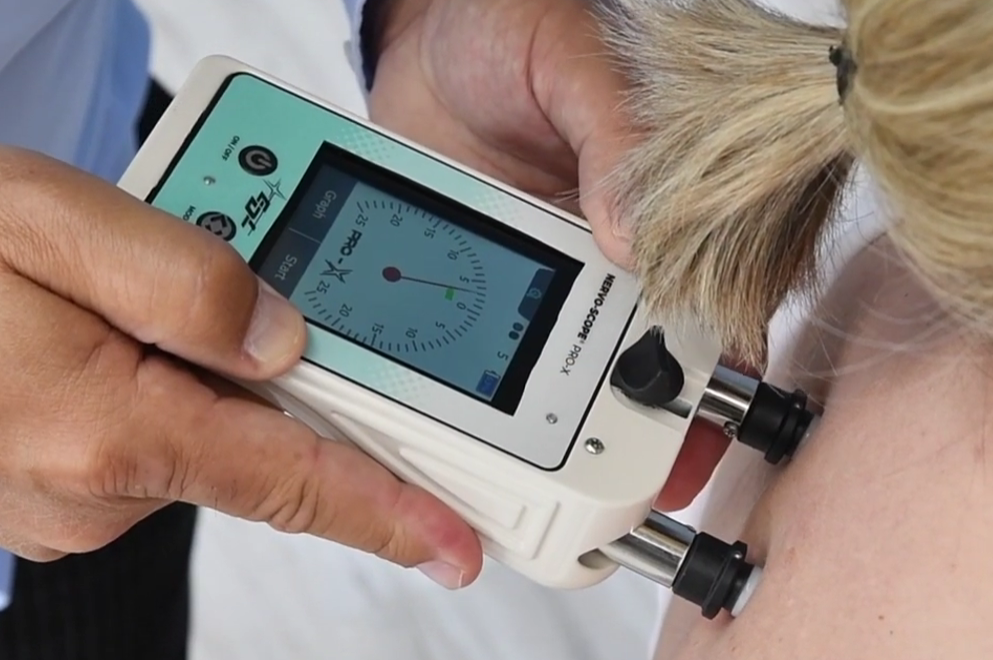
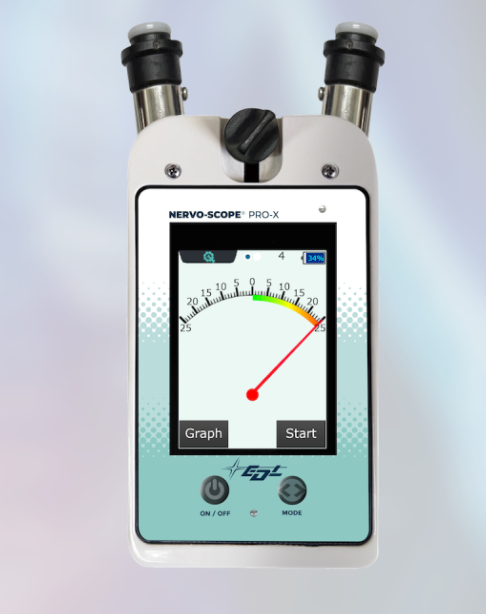
Your exam includes orthopedic and applied kinesiology muscle testing to distinguish a spinal nerve root problem from a piriformis entrapment — often in the first visit. We also run a paraspinal temperature scan as part of that exam.
Warm / hot reading
Can point to active nerve compression — inflammation and increased local blood flow from a nerve under acute pressure.
Low-to-medium reading
Can point toward a more chronic pattern — fibrosis and scar tissue that's been building for a while rather than a fresh, active flare.
That distinction — acute and inflamed versus long-standing and fibrotic — changes how aggressively, and in what order, we treat you.
What we actually do about it
Once we know what we're dealing with, treatment usually combines a few things, matched to what your case actually needs — not a fixed package handed to everyone who walks in.
Calming an overactive nerve signal
Fine needles placed at specific points help quiet the nervous system's alarm response, which is often loud, chronic, and out of proportion to what's actually left to heal — whether the irritation is coming from the spine or the hip.

Releasing scar tissue that's binding the nerve
When muscle and connective tissue around the piriformis, glute, or lower back get injured — even from something as ordinary as sitting for years, a fall, or an old injury that "healed" — the body can lay down dense, sticky adhesions as part of the repair process. Those adhesions bind tissue layers together that are supposed to glide freely. When they form across the sciatic nerve's pathway, they create the exact kind of mechanical compression that produces sciatic pain — and no amount of stretching, medication, or rest resolves adhesions, because they aren't inflammation. They're structural. They have to be found and physically released.

Reaching depth that hands and needles can't
For adhesions sitting deep in the glute and piriformis, past where hands and needles alone can effectively reach, our German-engineered super-pulsed laser delivers energy deep enough to help break down restricted tissue and calm inflammation at that depth — without a single needle, which matters both for reaching that specific area and for anyone who's avoided treatment in the past simply because they don't like needles.
.jpg)
This combination is often the missing piece for people who've "tried everything." Physical therapy stretches the muscle. Chiropractic addresses joint alignment. None of those directly target bound-down scar tissue gluing a nerve in place at a depth you can't reach from the outside with your hands alone.
Your first visit
You'll spend real time explaining what's going on — where the pain starts, where it travels, what makes it worse, what you've already tried and how your body responded. That last part matters more than people expect: how your body reacted to a cortisone shot or a chiropractic adjustment tells us something diagnostic, not just historical.
We listen
Where it hurts, what triggers it, what you've already tried — and how your body actually responded, which tells us something diagnostic.
We test
Orthopedic exam, applied kinesiology muscle testing, our paraspinal temperature scan, and hands-on assessment to find exactly where the problem is coming from — spine, hip, or both.
We treat what we found
A plan built around what we actually found, not a generic sciatica protocol. Most people feel some initial change early in care, though how quickly and how completely varies depending on how long the problem's been building.
Common questions
Does the treatment hurt?+
Acupuncture needles are extremely thin — most people are surprised by how little they feel them, and many find sessions genuinely relaxing. ARM is more direct; you may feel pressure or mild discomfort while we're working through a restricted area, similar to deep tissue work. The laser is painless — most people feel a mild, comfortable warmth, or nothing at all.
How many visits will this take?+
It depends on how long you've had it and what's actually driving it — a piriformis issue with adhesions responds differently than a herniated disc pressing on a nerve root. We'll give you a realistic assessment after your evaluation, not a number pulled from a brochure.
Do I need a referral?+
No. You can schedule directly with us.
Will it come back?+
That depends on whether the underlying cause gets resolved, not just the symptom. Part of our plan for you includes what to do — or avoid — to keep it from redeveloping once you're out of pain.
You've waited long enough.
If you've been managing this for months — working around it, planning your day around what will and won't set it off — that's long enough to have tried without an accurate answer. We're not going to promise you a miracle. We're going to test first, find out what's actually happening in your case, and treat that — not just the symptom that's been sending you down the wrong path.
Serving Meridian, Boise, Eagle, Nampa, Star, Kuna, and Caldwell.