
Meridian, ID · Boise · Eagle · Nampa
Gabapentin quiets the signal. It never touches the source. Our Neuropathy Treatment starts by finding out exactly what kind of nerve problem you actually have — then treats that, not just the symptom.
Book Your EvaluationA little tingling in your toes at the end of the day. A spot on your foot that feels asleep even after a full night's rest. Then the burning shows up. The numbness spreads. Some nights your feet feel like they're on fire, and other nights you can't feel the floor at all when you stand up out of bed.
You've probably already heard the word “neuropathy,” and you've probably already been handed a prescription for gabapentin or Lyrica — pills that make you foggy and tired, and that treat the signal, not the source. You take them and the pain gets a little quieter. You stop taking them and it's right back. That's not treatment. That's a dimmer switch on a problem that's still very much there.
If you're in Meridian, Boise, Eagle, or Nampa and you're tired of managing nerve pain instead of treating it, our Neuropathy Treatment approach starts by figuring out exactly what kind of nerve problem you actually have — because “neuropathy” is a symptom, not always a diagnosis.
Not all nerve pain labeled “neuropathy” is actually diffuse peripheral neuropathy. There are two very different problems that can look nearly identical, and they need two very different approaches.
Symmetric — both feet, both hands, classic “glove and stocking” pattern. Driven by something systemic: diabetes, B12 or nutritional deficiency, autoimmune disease, or medication side effects. The nerve endings themselves are under attack.
Usually one-sided. Follows the path of a single nerve — burning down one leg from a compressed nerve root, or numbness in the thumb and fingers from a pinched nerve at the wrist, neck, or shoulder. One nerve, somewhere along its path, is being squeezed or irritated.
If your “neuropathy” is actually a single nerve being compressed somewhere in the spine, no amount of treating your feet is going to fix it. Finding the real point of compression is the first thing we sort out, before we ever start treatment.
We map your symptom pattern first: both feet or one side, glove-like or following a nerve's exact path, gradual onset or tracing back to an injury. When the pattern points toward a possible focal or spinal component, we use a paraspinal temperature-scanning device — the Nervo-Scope Pro-X — to check for a temperature differential along either side of your spine.
Often points to active nerve compression or inflammation with increased local blood flow — a current, active problem at that level of the spine.
Can point to a more chronic pattern of fibrosis or scar tissue that's built up over time, changing how aggressively we treat the area.
For patients whose pattern looks like true diffuse peripheral neuropathy — symmetric, both feet, gradual onset, often tied to diabetes or blood sugar issues — this spinal scan isn't the right diagnostic tool, and we won't pretend it is. Diffuse neuropathy calls for a different plan centered on nerve tissue health and circulation.
![Nervo-Scope Pro-X paraspinal scan in use — Meridian, ID clinic]](https://cdn.prod.website-files.com/6a8708d65d01f6f5ce4799e8/6aaacc81b37391e5037e1fd3_nervoscope%20landscape.png)
The centerpiece of treatment for diffuse peripheral neuropathy. A needle-free way to deliver concentrated light energy into tissue to support circulation and nerve health at a cellular level. It lets us treat broad areas of the feet, lower legs, or hands efficiently — ideal for needle-averse patients or symptoms too widespread for point-by-point needling.
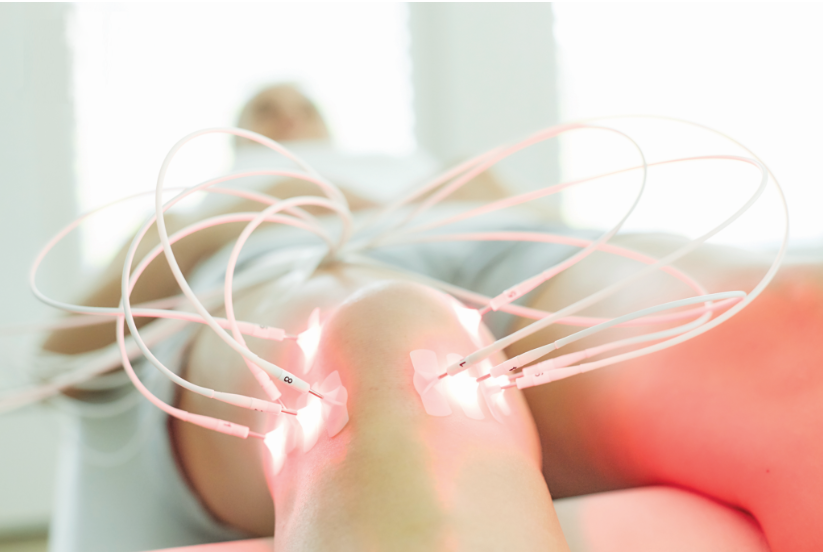
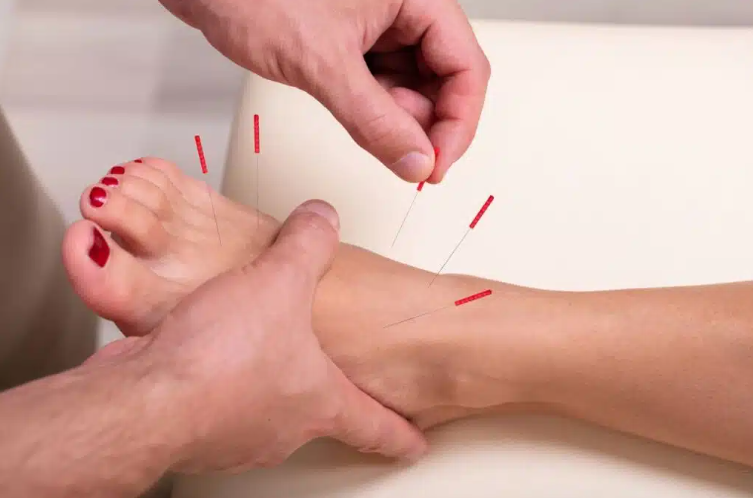
Paired with the laser to support local circulation and modulate how the nervous system processes pain signals — calming the constant “static” of burning and tingling.
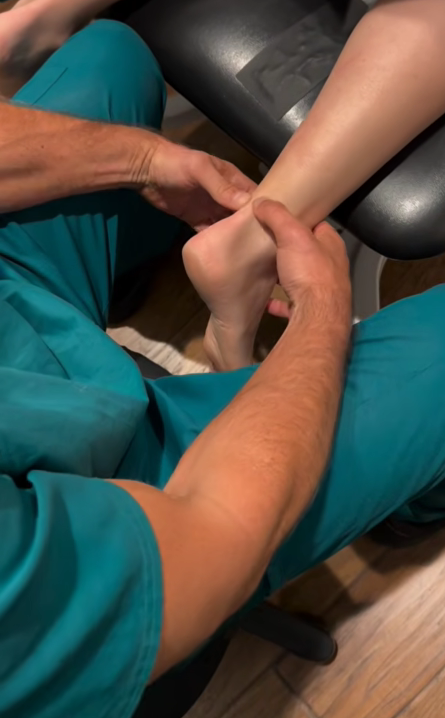
Reserved for a focal, compression-based component — the kind seen with a spinal nerve root issue or carpal tunnel. ARM releases the soft-tissue adhesions and restrictions physically pressing on or tethering the nerve, going directly after the point of compression our diagnostic mapping identifies.
Most patients get a combination: laser to support nerve tissue and circulation broadly, acupuncture to calm pain-signal processing, and ARM where an actual mechanical compression component has been identified. Your neuropathy isn't the same as your neighbor's, and neither is your plan.
We won't tell you nerve damage always fully reverses, because that isn't true. Nerve tissue heals slowly, and how much function comes back depends on how long the problem has been present, how severe the damage is, and what's driving it.
What we can tell you honestly: many patients see real improvement in pain levels, sleep, and daily function, even when the underlying nerve damage doesn't disappear completely. Reducing the burning enough to sleep through the night. Reducing the numbness enough to feel your feet well enough to catch your balance. For patients with a focal compression component, results can be more dramatic once the actual restriction is released. We'll tell you early, honestly, what your case looks like and what's realistic.
2
Talk is easy. Here's what this actually looks like in practice.
One patient came to us after twelve years on medication for Crohn's disease — the neuropathy from it was severe. Pain and numbness ran from her knees all the way down to her feet. She couldn't feel scalding hot water on her skin. She couldn't feel her own feet well enough to control them safely behind the wheel of a car. In two months of treatment, we brought that neuropathy back from the knee down to just the ankle and foot — and she got real feeling back over that entire span in between. That's not a symptom “managed.” That's territory taken back.
Another patient came in with numbness in both feet. After one month of treatment, he had roughly 90% of that feeling back.
We've also worked with cancer patients dealing with neuropathy as a side effect of chemotherapy — one of the most common reasons oncology patients have to stop or reduce treatment they still need. We've been able to help several of them keep that neuropathy at bay during active chemo, so they can stay on their treatment schedule without the added fear of permanent nerve damage stacking on top of everything else they're already fighting.
These aren't guarantees — every case is different, and how much feeling comes back depends on the cause, the severity, and how long the nerve has been compromised. But this is what's possible when the actual source of the problem gets treated, not just the symptom.
Yes. Diabetic peripheral neuropathy is one of the most common forms of diffuse neuropathy we see from patients across Meridian, Boise, and the Treasure Valley. Our laser and acupuncture approach works alongside your medical management of diabetes — it doesn't replace it.
Your neurologist likely focused on diagnosis and medication management. We add a treatment approach aimed at your symptoms and, where a mechanical compression component exists, at removing the actual physical cause.
No. The super-pulsed laser is needle-free and non-invasive. Most patients feel a mild warmth or nothing at all.
It depends on whether your case is primarily diffuse, primarily focal, or a mix of both, and how long you've had symptoms. We give you a realistic treatment plan after your first evaluation.
That's exactly why we map your symptom pattern and use the paraspinal scan before starting treatment. If your case looks focal, we shift our approach toward locating and releasing that compression with ARM.
Serving patients across Meridian, Boise, Eagle, and Nampa. Your first visit starts with a real evaluation — not a guess.
Schedule Your Evaluation